
Indian benchmark indices, Sensex and Nifty, saw declines in early trade, influenced by rising crude oil prices and ongoing geopolitical tensions in West Asia. Experts suggest that crude oil remains a primary concern, with Brent holding near USD 88 a barrel due to renewed US warnings against Iran, embedding a geopolitical risk premium in energy markets. Track Sensex, Nifty

A Liberia-flagged oil tanker, Aframax Rio, carrying 23 Indian nationals, was attacked by drone boats off Russia's Black Sea coast near Sochi. All crew members were safely evacuated, though a significant fire is burning. The incident highlights escalating risks to commercial shipping in the Black Sea amid the Russia-Ukraine conflict, prompting India to express grave concern over attacks on international waterways.

Indian equities, particularly the Nifty 50, have significantly underperformed their Asian and global counterparts over the past year, with the index down 10.6 per cent. This lag is attributed to factors like rising global oil prices, rupee depreciation, and a lack of participation in the global chipmaker rally that boosted markets like South Korea and Taiwan.

They had bought Rs 29,631 crore worth of shares in August.

Indian stock markets closed lower, with the Sensex falling 429 points, after the Reserve Bank of India raised its benchmark interest rate for the first time in nearly four years, coupled with rising crude oil prices and persistent foreign fund outflows.
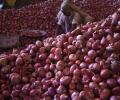
India's retail inflation surged to 5.54 per cent in September, primarily due to a significant increase in onion and other food prices, remaining just within the Reserve Bank of India's tolerance band. This marks the highest inflation since the new series with base year 2024 took effect in January.

US President Donald Trump is expected to sign the Lindsey O. Graham Sanctioning Russia and Iran Act of 2026 later on Friday (local time). A White House official confirmed the development to ANI without revealing further details.

A two-day weekend would help employees recover physically and mentally. They would return better prepared for branch work that demands patience, judgment, and accuracy, asserts Tamal Bandyopadhyay.

US President Donald Trump has expressed strong support for the India-Middle East-Europe Economic Corridor (IMEEC), citing the necessity to move energy infrastructure away from Iranian checkpoints following attacks in West Asia. He made these remarks during a multilateral meeting with the Gulf Cooperation Council at the UN General Assembly, emphasising the corridor's role in overcoming regional challenges.
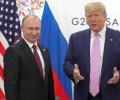
Former President Donald Trump's recent deal with Russia to supply diesel to the US and global markets has ignited a political firestorm, drawing sharp criticism from Ukraine's President Volodymyr Zelenskyy, Democratic leaders, and a segment of Republicans, despite the US Treasury lifting sanctions on Russian diesel supplies.

Reserve Bank of India Governor Sanjay Malhotra has stated that the rupee may be 'undervalued' by many estimates and assured that the RBI will work to ensure its stability and help it find its 'correct value' amidst recent depreciation.

Rajasthan Governor Haribhau Bagde highlighted ethanol's potential to protect India from volatile petroleum markets and geopolitical risks, advocating for its widespread production and use. He, along with other officials, emphasised ethanol's role in strengthening the rural economy, ensuring timely cane payments, and combating carbon emissions, while also discussing its historical context and current government support.

Indian equity benchmarks Sensex and Nifty rallied up to 1 per cent in early trade, driven by strong performance in IT stocks, Reliance Industries, and favourable global market sentiment, rebounding from previous losses.
The bill, introduced on Thursday, was conceived by Democrat Senator Richard Blumenthal and late Republican Senator Lindsey Graham and has the support of over 60 lawmakers.

Indian equity markets, led by the Nifty 50, saw gains following a pullback in Brent crude prices towards $101-102 a barrel and weaker-than-anticipated US jobs data, which eased concerns about a Fed rate hike. However, analysts caution that markets are likely to remain volatile in the near term.
Indian benchmark indices Sensex and Nifty closed lower, with the Sensex dropping 388 points and Nifty declining 112 points, as a sharp rally in crude oil prices, driven by geopolitical uncertainties and concerns over the Strait of Hormuz, dampened investor sentiment and reignited inflation fears.

Foreign Portfolio Investors (FPIs) became net sellers in September, withdrawing Rs 35,860 crore from Indian equities due to global uncertainties, high US interest rates, and elevated crude oil prices, with outflows continuing into October.

Indian benchmark equity indices, Sensex and Nifty, ended sharply lower, with the Sensex tumbling 876.37 points and the Nifty dropping below 22,900, primarily due to a decline in private bank stocks like HDFC Bank and Axis Bank, alongside weak global market trends.

FPIs have already withdrawn Rs 2.6 trillion from Indian equities in 2026, exceeding the outflows recorded in any previous full calendar year.
Indian benchmark indices Sensex and Nifty saw a significant rebound in early trade, with the Sensex surging over 700 points, driven by a decline in crude oil prices, easing concerns over Federal Reserve tightening, and the appointment of Anup Bagchi as the new MD and CEO of HDFC Bank.

Finance Minister Nirmala Sitharaman stated that the Reserve Bank of India (RBI) will persist in its efforts to prevent excessive volatility in the rupee, which has significantly depreciated against the US dollar due to global uncertainties, despite India's strong macro-economic fundamentals.

State-run Oil and Natural Gas Corporation (ONGC) has approved the development of a 1.75 million tonnes (mt) strategic petroleum reserve (SPR) in Mangaluru, a project deemed of national importance, with plans for broad commercial utilisation.
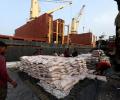
India's exports saw a significant increase of 26.12 per cent to USD 43.81 billion in August, leading to a narrowed trade deficit of USD 26.86 billion, driven by strong demand from key global markets and diverse sectors.
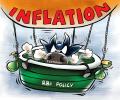
The Reserve Bank of India (RBI) has marginally raised its retail inflation forecast for the current fiscal year (FY27) to 5.2 per cent from 5 per cent, citing increasing price pressures across various commodities. Concurrently, the Monetary Policy Committee (MPC) unanimously decided to hike the key interest rate (repo) by 25 basis points to 5.5 per cent, shifting its stance to 'calibrated tightening'.

After a significant 9.9% depreciation in FY26, the Indian rupee has shown comparative stability in the first half of FY27, depreciating by only 1.1%, attributed to regulatory interventions and measures to attract foreign capital, despite ongoing global pressures from rising crude oil prices and foreign investor outflows.

The Indo-Tibetan Border Police (ITBP) is undergoing a significant modernization drive, establishing drone platoons, developing a new 'Strike' course for Galwan-like situations, and constructing underground infrastructure along the Line of Actual Control. This strategic shift, announced by DG Shatrujeet Singh Kapoor, aims to counter China, identified as India's 'biggest adversary,' by embracing modern warfare techniques learned from recent global conflicts.
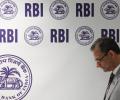
The Reserve Bank of India on Wednesday raised its policy repo rate by 25 basis points to 5.50 per cent, beginning a rate-hike cycle as rising inflation risks, elevated global yields and resilient domestic growth strengthened the case for tighter monetary policy. The decision by the Monetary Policy Committee marks a shift from its August policy, when it kept the repo rate unchanged at 5.25 per cent and retained a neutral stance while seeking greater clarity on the inflation outlook and growth-inflation balance.

The Reserve Bank of India's Monetary Policy Committee (MPC) has indicated that rate cuts are improbable in the near term, with headline inflation projected to reach 6 per cent in the third quarter. Minutes from the October meeting reveal growing concerns among members about inflation spreading beyond food and fuel, leading to a shift in policy stance towards calibrated tightening.

Moody's Ratings has sharply increased India's GDP growth forecast for fiscal 2026-27 to 7 per cent, making it the fastest among G20 economies, driven by economic resilience despite the Middle East conflict. However, the agency flagged significant inflation risks stemming from elevated oil prices and potential El Nino disruptions.

Indian Oil Corporation Ltd (IOCL) plans to invest approximately Rs 1 trillion in petrochemical projects over the next five to six years, aiming to significantly increase its petrochemical intensity and production capacity to meet growing domestic demand.

Every time you step into the kitchen it's quite possible to create a version of eggs that's far tastier than the last time you made eggs.

India on Tuesday reiterated the call for free and safe navigation in international waters and the unhindered flow of commerce through international waterways in the region after the Panama-flagged commercial vessel MT El Gaia came under attack off the coast of Oman, with 13 of the 14 Indian nationals on board rescued while search operations are underway for one missing seafarer.

Analysts predict that crude oil prices, geopolitical tensions in West Asia, and upcoming inflation data will be the primary drivers of the Indian stock market this week, alongside foreign investor activity and domestic quarterly earnings.

Indian IT stocks have experienced their most significant weekly surge in 18 years, with the Nifty IT index climbing 11.72 per cent, as a global sell-off in AI-linked equities redirected investor attention towards India's IT services sector. This shift aligns with a JP Morgan report identifying India as a 'natural AI hedge' due to its large, liquid market and strong domestic institutional investor base.

India's new captain Smriti Mandhana is set to lead the women's team in a T20I series against Zimbabwe, marking a new era. She aims to elevate the team's professionalism, power-hitting, and fielding, while fostering a strong team culture. Mandhana also highlighted the importance of Harmanpreet Kaur's experience and praised deputy Shafali Verma's growth, as the team prepares for the ICC Women's Champions Trophy 2027.

Five Indian nationals aboard a Kuwait-flagged tanker were safely shifted ashore after the vessel was struck by a projectile in the Strait of Hormuz, the Embassy of India in Oman said.

The reopening of the Strait of Hormuz, following a ceasefire agreement between the US and Iran, is expected to significantly ease India's crude oil supply risks, lower freight costs, and reduce inflationary pressures, as global oil prices have already dropped.

Indian benchmark indices Sensex and Nifty experienced volatile trading, influenced by elevated crude oil prices, high US bond yields, and selling pressure in IT stocks, despite an early rebound.

Indian benchmark indices, Sensex and Nifty, closed lower, primarily due to a downturn in banking and financial stocks, coupled with crude oil prices remaining above USD 80 per barrel. Geopolitical uncertainties and new regulatory proposals for the non-bank lending sector also contributed to cautious investor sentiment.

Prime Minister Narendra Modi celebrated India's 7.8 per cent GDP growth in the April-June quarter, attributing it to the collective strength of the people despite global uncertainties. He criticised "doomsayers" as the economy showed resilience, exceeding expectations even amidst international conflicts and supply chain issues.
